How Car Dealerships Can Turn Their Service Drive Into More Sales and Vehicle Acquisitions
Is your dealership struggling with your service to sales process? Every day, car dealerships welcome customers into their service departments who already have a relationship with the dealership.
They know your brand. They know your service advisors. They know your facility. They have already trusted your dealership enough to bring their vehicle in for maintenance or repairs.
Yet many of those same customers eventually purchase their next vehicle somewhere else.
For a dealership General Manager, that creates an important question:
What would happen if every repair order became an opportunity to identify the customer’s next vehicle purchase—and an opportunity to acquire the vehicle they currently drive?
That is the opportunity behind ROboT by CognitGo.
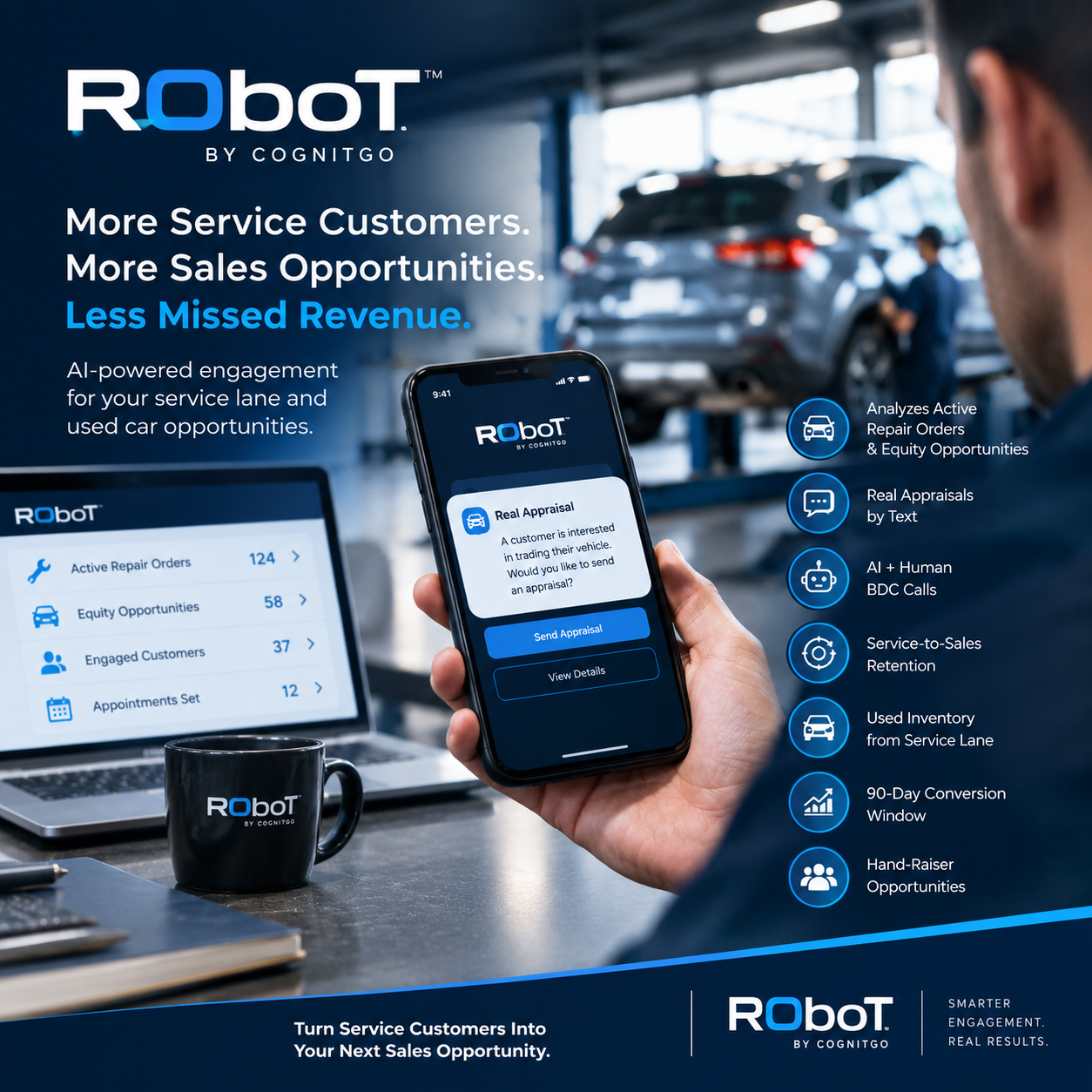
ROboT is a service to sales and vehicle acquisition platform designed for franchised new car dealerships. It connects the service drive, sales department, BDC, and used-car acquisition process into one operation.
Instead of allowing service customers to leave the dealership without a sales conversation, ROboT uses the repair order as the trigger for identifying opportunities, creating a vehicle valuation, engaging the customer, and ultimately setting appointments for the dealership’s sales team.
The objective isn’t simply to generate more leads.
The objective is to turn service-drive activity into appointments, vehicle acquisitions, and sales.
The Service Drive May Be One of Your Dealership’s Most Underutilized Sales Opportunities
Your service department already has something many lead-generation programs spend enormous amounts of money trying to create:
Existing customer relationships.
Every repair order represents a customer who has physically brought a vehicle to your dealership.
That customer has already demonstrated several valuable signals.
They own a vehicle.
They maintain that vehicle.
They have a relationship with your dealership.
They are physically on your property.
And depending on the vehicle’s age, mileage, equity position, repair needs, warranty status, and ownership cycle, they may eventually be in the market for another vehicle.
The challenge is identifying those opportunities consistently.
A salesperson walking through the service drive may notice a customer with a desirable vehicle. A service advisor may recognize that a vehicle is approaching an expensive repair. A manager may know that certain customers are strong candidates for an upgrade.
But manually identifying and following every opportunity is difficult.
That’s where automation and a dedicated BDC operation can change the process.
What Is ROboT?
ROboT stands for Repair Order Bot.
It is designed around a simple concept:
The repair order becomes the starting point for a service-to-sales and vehicle acquisition conversation.
When a repair order opens, ROboT reads the available information and begins working the opportunity.
The system reads the repair order, identifies the specific vehicle, pulls the factory build information for that VIN, uses the dealership’s existing appraisal process, checks vehicle history, and creates an offer.
The customer can then be asked whether they would like to know what their vehicle is worth.
If the customer responds positively, a human BDC representative takes over the conversation.
The goal is to move that interaction toward a real appointment for the dealership’s team and improve your service to sales process.
ROboT’s process consists of six primary steps:
- The repair order opens.
- The vehicle’s actual factory build sheet is identified.
- The vehicle is booked through the dealership’s appraisal process.
- The customer is asked whether they want to know what their vehicle is worth.
- A human BDC representative engages the customer.
- A qualified appointment is set and handed to the dealership.
According to CognitGo, the automated portion of the process can happen in approximately 15 minutes on average.
Why the Repair Order Matters
A generic customer list doesn’t necessarily tell you when someone is ready to have a conversation.
A repair order provides context.
The customer is actively interacting with the dealership.
The dealership knows what vehicle they own.
The dealership knows why the vehicle is there.
The vehicle can be evaluated based on its actual equipment and history.
That creates a natural reason to start a conversation.
Instead of sending a generic message saying:
“We’re interested in buying your car.”
ROboT can start with a more relevant question:
“Would you like to know what your vehicle is worth?”
That difference matters.
The conversation begins with something useful to the customer rather than simply asking them to buy another vehicle.
Build-Sheet Accuracy Can Change the Conversation
One of the challenges with vehicle valuations is accuracy.
A generic VIN decode may identify the year, make, model, and trim, but it may not accurately capture every factory-installed option and package on that specific vehicle.
ROboT uses the actual factory build sheet for the VIN.
That means the system can account for factory-installed equipment and packages when preparing the valuation.
After the build sheet is identified, ROboT books the vehicle inside the dealership’s existing appraisal tool and incorporates vehicle-history information.
The goal is to create an opening valuation based on information the dealership can actually work with rather than sending a generic estimate that may change dramatically when the customer arrives.
For a dealership, that creates a more credible starting point for the conversation.
For the customer, it provides a reason to engage.
ROboT Does Two Jobs for the Dealership
The technology is only part of the story.
ROboT is designed around two dealership objectives.
1. Keep Service Customers in the Dealership’s Ecosystem
A service customer can eventually buy their next vehicle from any dealership.
The fact that they service with your dealership does not automatically guarantee that they will purchase their next vehicle from you.
ROboT is designed to create a service to sales process that runs smoothly and help with getting more sales conversations going while the customer is already connected to your dealership.
The customer can receive a valuation conversation while their vehicle is in service, giving the dealership an opportunity to introduce a purchase or trade discussion.
Instead of waiting for the customer to submit a lead months later, the dealership can begin building awareness before the customer decides where to shop.
2. Acquire Used Inventory From Your Own Customer Base
The second objective is vehicle acquisition.
Dealerships constantly need quality used inventory.
But finding the right vehicles can be difficult.
Auction inventory can be expensive. Trade-ins depend on customers buying another vehicle. Online acquisition programs can generate volume without necessarily producing the exact vehicles a dealership wants.
The service drive provides another potential source.
Your customers are already bringing vehicles to you.
ROboT is designed to identify vehicles that may represent acquisition opportunities and start a conversation with those owners.
This creates a connection between fixed operations and used-car inventory.
What Happens to the Lead After the Customer Responds?
This is one of the most important parts of the ROboT model.
ROboT does not simply send a message and leave the dealership with another lead to manage.
When a customer engages, a human BDC representative gets involved.
That distinction is important because customers can have questions, objections, timing issues, financing concerns, trade questions, or other reasons they may not immediately schedule an appointment.
A human can have that conversation.
The objective is to qualify the opportunity and set an appointment for the dealership.
The dealership’s team then receives the opportunity with context rather than simply receiving a name and phone number.
Why Follow-Up for 90 Days Matters
A customer who doesn’t buy today isn’t necessarily a dead lead.
They may be three weeks away.
They may be waiting for a bonus.
They may be discussing the purchase with their spouse.
They may be waiting for a lease to mature.
They may want to complete a repair before deciding.
They may simply not be ready yet.
That is why ROboT is designed to work the customer for up to 90 days rather than abandoning the opportunity after a few messages.
CognitGo says its system tracks touches, replies, appointments, and matched deals throughout the process.
For dealership leadership, this changes the question from:
“Did the customer buy today?”
to:
“Are we staying in the conversation until the customer is ready?”
That is a much more useful way to think about service-to-sales opportunities.
ROboT Works With the Systems Your Dealership Already Uses
One of the biggest concerns with adding another technology platform is implementation.
Dealership teams already have enough systems.
ROboT is designed to work with the dealership’s existing technology stack rather than requiring the dealership to replace everything.
According to CognitGo, ROboT can integrate with DMS platforms including CDK, Reynolds & Reynolds, Dealertrack, and others.
It also works with existing appraisal tools such as vAuto and pushes qualified opportunities into the dealership’s CRM.
That means your team can continue working within the systems they already know.
The objective is to add an operating process—not another dashboard that your employees have to remember to check.
What Does ROboT Actually Do for a GM?
For a General Manager, the bigger question isn’t whether the technology is interesting.
The question is:
What does this do for my dealership?
ROboT is designed to address several dealership priorities at the same time:
More service to sales opportunities
Service customers can be identified and engaged while they are already interacting with your dealership.
More qualified appointments
The human BDC works engaged customers and attempts to convert conversations into appointments.
More used-car acquisition opportunities
Vehicles coming through the service drive can become potential acquisition opportunities.
Better utilization of service traffic
The dealership has already invested in generating service traffic. ROboT creates another process for turning that traffic into sales and acquisition opportunities.
Long-term customer engagement
Customers who aren’t ready immediately can continue through a longer follow-up process.
Measurable reporting
Dealership leadership can track activity, appointments, and matched transactions.
The goal is to connect the activity to actual dealership outcomes rather than stopping at lead volume.
What Results Has ROboT Reported?
CognitGo publishes monthly results for the ROboT operation.
For May 2026, CognitGo reported activity across 69 dealership rooftops.
The reported numbers included:
- 67,815 repair orders analyzed
- 32,865 customers messaged
- 8,706 customers who raised their hand
- 1,597 appointments set by the BDC
- 903 vehicles acquired
- 1,346 vehicles sold to customers reached
- 2,249 total vehicles transacted
CognitGo states that the figures are audited and publishes the funnel so dealerships can see the activity from repair orders through transactions.
Those numbers should be viewed as reported results from our operation rather than a guarantee of what an individual dealership will produce. Actual results can vary based on service volume, customer mix, inventory needs, implementation, and other dealership-specific factors.
But the underlying concept is straightforward:
If a dealership has service customers, it has potential service to sales and acquisition opportunities.
How Should a GM Measure a Program Like ROboT?
One of the most important questions for a General Manager is how to determine whether a program is actually producing a return.
Lead volume alone isn’t enough.
A dealership can receive thousands of leads and still produce disappointing results.
The more useful metrics are downstream.
Consider measuring:
- Repair orders analyzed
- Customers contacted
- Customer responses
- Qualified opportunities
- Appointments set
- Appointments shown
- Vehicles acquired
- Vehicles sold
- Matched deals
- Gross profit
- Cost per acquisition
- Cost per sale
- Total return on investment
ROboT specifically recommends evaluating the program based on cost per deal rather than cost per lead.
That’s an important distinction.
A lead is an opportunity.
A vehicle acquired or sold is an outcome.
For dealership leadership, outcomes are what ultimately matter.
What Happens to Your Existing BDC?
ROboT isn’t positioned as a replacement for a dealership’s existing BDC or internet team.
Instead, the objective is to give the dealership’s people better opportunities to work with our service to sales AI technology.
Instead of having dealership employees spend their time trying to identify which service customers might be interested in trading, they can receive qualified appointments with information already gathered.
That allows the dealership’s team to focus more of its time on the conversations that are further along.
The automation identifies and starts the opportunity.
The human BDC works the conversation.
Your dealership team handles the appointment and the vehicle transaction.
Is ROboT an AI Voice Bot?
No. This is an important distinction for dealership leaders who have already tested AI communication tools.
ROboT uses AI for the repair-order analysis, valuation workflow, text communication, data processing, and follow-up intelligence.
But when a customer needs to have a phone conversation, a human BDC representative handles the call.
CognitGo specifically states that ROboT is not a voice bot pretending to be a person.
The philosophy is simple:
Use automation where automation is efficient. Use humans where human interaction matters.
What If Your Dealership Has Already Tried an AI Vendor?
That’s a fair question.
Many dealerships have tested technology that promised to generate more appointments but ultimately produced another pile of leads for employees to manage.
ROboT takes a different approach.
The process begins with the service customer and the actual repair order.
The vehicle is valued using specific vehicle information.
The customer is asked rather than simply blasted.
A human BDC follows up.
And the opportunity can remain active for up to 90 days.
The goal is to create an operating process rather than simply sell another piece of software.
Frequently Asked Questions About ROboT
What is ROboT for car dealerships?
ROboT is a service to sales and vehicle acquisition platform designed for franchised new car dealerships. It uses repair orders to identify opportunities, engage service customers, generate vehicle valuations, and work qualified customers toward appointments.
How does ROboT generate dealership sales opportunities?
ROboT analyzes repair orders, identifies the vehicle and its equipment, creates an appraisal through the dealership’s existing process, and starts a conversation with the customer. Engaged customers are then worked by a human BDC toward an appointment.
Does ROboT replace a dealership BDC?
No. ROboT includes its own human BDC operation and is designed to provide the dealership’s team with qualified appointments rather than replace its existing sales or BDC staff.
Does ROboT use AI?
Yes. AI is used throughout the workflow, including repair-order analysis, communication, call transcription, analysis, and follow-up intelligence. The phone conversation with an engaged customer is handled by a human BDC representative.
How long does ROboT follow up with customers?
ROboT is designed to work customers for up to 90 days rather than stopping after the first few days of follow-up.
Does ROboT require a new CRM?
No. ROboT is designed to work with the dealership’s existing CRM and DMS environment and push qualified opportunities into the CRM the dealership already uses.
Can ROboT help dealerships acquire used inventory?
Yes. Vehicle acquisition is one of the two primary objectives of ROboT. The system identifies potential acquisition opportunities among service customers and works to create conversations around purchasing their vehicles.
Your Service Drive Is More Than a Fixed Operations Department
For many dealerships, service is viewed primarily as a fixed-operations revenue center.
But the service drive can also be a source of:
Service to Sales opportunities.
Trade opportunities.
Used inventory.
Customer retention opportunities.
The customers are already there.
The vehicles are already there.
The relationships are already there.
The question is whether your dealership has a consistent process for turning that activity into measurable opportunities.
ROboT is built around that process.
It connects repair orders to vehicle valuations, customer engagement, human BDC follow-up, appointments, acquisitions, and sales.
And rather than asking dealership leadership to simply trust a sales pitch, we publish our results and offer dealerships the opportunity to review an actual dealer report.
See What ROboT Could Do for Your Dealership
If you’re a General Manager, Dealer Principal, GSM, or dealership executive, the best way to understand ROboT isn’t through another generic product presentation.
See the service to sales process
See how a repair order becomes an opportunity
See how the vehicle is valued
See how the customer is engaged
See how the human BDC works the opportunity
And most importantly, see how the activity is measured
Book a ROboT demo with us and see how your dealership can turn service-drive traffic into sales opportunities and vehicle acquisitions with our service to sales AI technology.
Don’t just ask how many leads a system can generate. Ask how many appointments, vehicles, acquisitions, and sales it can help your dealership produce.
Your service drive is already full of customers. The next question is what your dealership does with those opportunities and how you can improve your service to sales process with our help.