Looking for the best AI service drive technology for your car dealership? Every day, customers bring vehicles into the dealership for oil changes, maintenance, repairs, warranty work, tires, inspections, and major service. These customers already have an established relationship with the dealership. They know the brand. They know the service department. They have already demonstrated that they trust the dealership enough to bring their vehicle back.
Yet many dealerships treat the service drive primarily as a service revenue center instead of recognizing its enormous potential as a sales and vehicle acquisition channel.
That is beginning to change.
With the emergence of AI service drive technology, dealerships can now analyze repair orders, identify vehicles that may be candidates for acquisition or replacement, determine accurate vehicle values, engage customers through text, and have a human BDC follow up with qualified opportunities.
One of the technologies designed around this concept is ROboT, a service-to-sales and vehicle acquisition platform built specifically for franchised new car dealerships. ROboT uses the repair order as the trigger for an automated process that can ultimately connect service customers with the dealership’s sales team.
The concept is simple:
A customer comes in for service. The dealership identifies an opportunity. AI starts the conversation. A human BDC develops the relationship. The sales team gets a qualified appointment.
That changes the role of the service drive completely.
What Is AI Service Drive Technology?
AI service drive technology is software designed to help dealerships identify and act on sales and vehicle acquisition opportunities within their existing service customer base.
Instead of waiting for a service customer to walk into the showroom and ask about a new vehicle, an AI-powered system can use information already generated by the dealership’s systems to identify potential opportunities.
The process can begin when a repair order opens.
ROboT, for example, reads the repair order in real time, accesses the vehicle’s actual factory build information, values the vehicle through the dealership’s existing appraisal system, reviews vehicle history, and begins a customer communication process.
This creates a connection between two departments that have traditionally operated somewhat independently:
Service + Sales
The result is what is commonly referred to as service-to-sales.
Rather than allowing a valuable service customer to eventually purchase their next vehicle from another dealership, the dealership has an opportunity to begin the conversation while the customer is already on its property.
Why the Service Drive Is Such a Valuable Sales Opportunity
Consider what a dealership already knows about its service customers.
The dealership may have access to:
- Vehicle identification information
- Repair orders
- Mileage
- Service history
- Customer information
- Vehicle ownership history
- Factory-installed equipment
- Vehicle history
- Existing CRM information
- Previous interactions
- Appraisal information
This is significantly different from buying an anonymous internet lead. A service customer is already connected to the dealership.
They have already taken an action that demonstrates intent and ownership: they brought their vehicle in for service.
The challenge is identifying which of those customers may be interested in selling or replacing their vehicle—and then having the resources to follow up consistently.
This is where artificial intelligence can make a significant difference.
From Repair Order to Sales Opportunity
The foundation of ROboT is its ability to use the repair order as the starting point for the process.
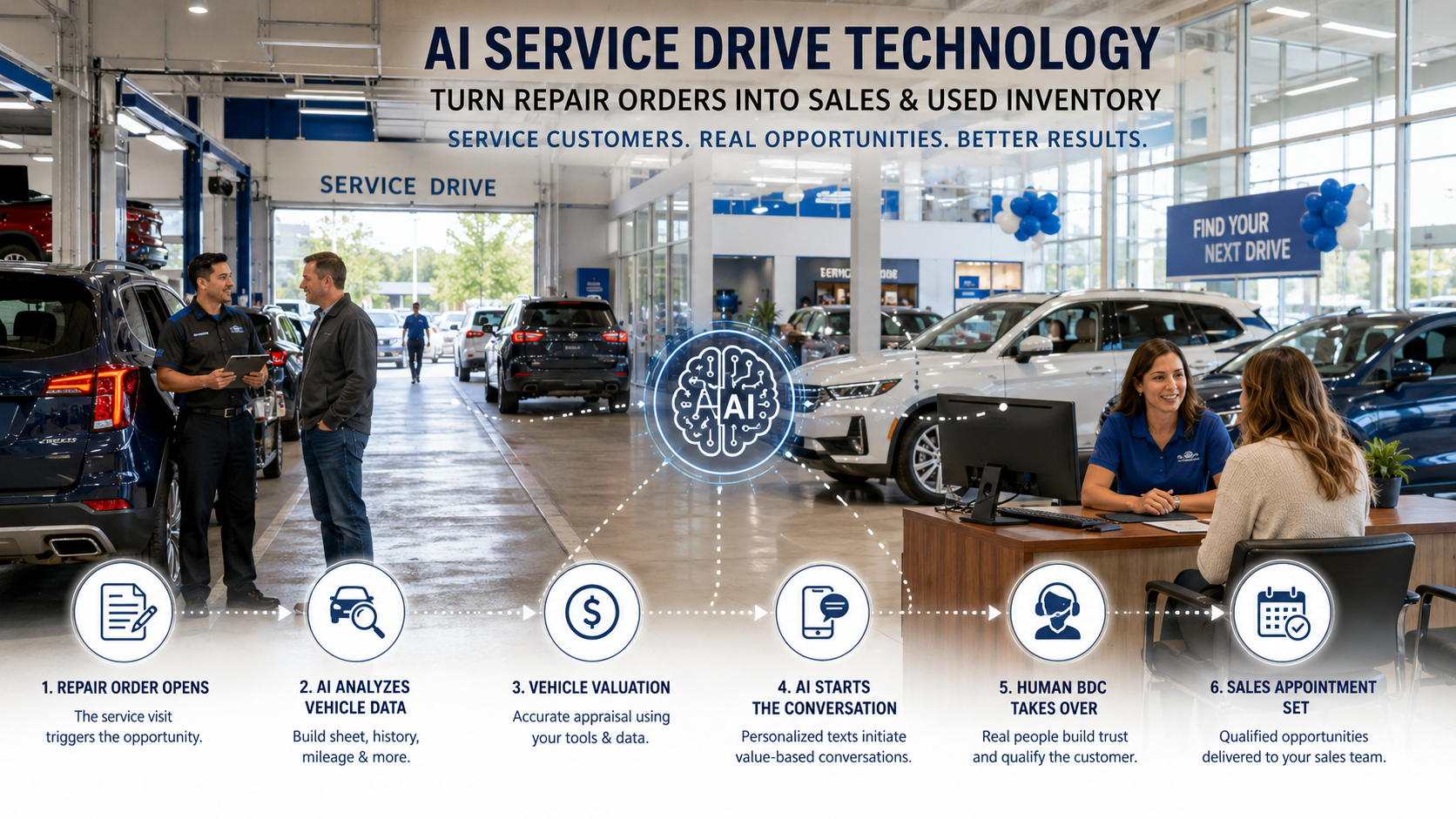
The basic workflow consists of six stages:
1. The Repair Order Opens
When the customer arrives for service, the repair order becomes the trigger.
Rather than allowing the customer interaction to end when the service appointment is completed, the dealership can begin evaluating whether the vehicle represents a potential sales or acquisition opportunity.
2. AI Reads the Vehicle Build Sheet
One of the important distinctions in the ROboT process is the use of the vehicle’s actual factory build information.
A generic VIN decode may identify the basic vehicle, but it may not accurately account for every package and factory-installed option.
For example, two vehicles may have the same year, make, model, and trim but have substantially different equipment.
One may have premium packages, upgraded interior features, towing equipment, safety packages, or other options.
Those differences can affect the vehicle’s value.
ROboT uses the actual factory build sheet to identify the equipment associated with the specific VIN.
That creates a more informed starting point for the appraisal.
3. The Vehicle Is Appraised
After identifying the vehicle’s equipment, the system books the vehicle through the dealership’s existing appraisal technology.
ROboT is designed to work with the dealership’s existing appraisal philosophy rather than forcing the dealership to adopt a completely different valuation process.
Vehicle history is also considered.
Carfax or AutoCheck information can help identify factors such as:
- Previous accidents
- Rental history
- Title issues
- Other vehicle-history considerations
The result is intended to provide a credible opening valuation rather than simply sending the customer a generic purchasing message.
4. AI Service Drive Technology Starts the Conversation
This is another important distinction.
The objective isn’t simply to send customers a mass text saying:
“We want to buy your car.”
Instead, the process can begin by asking the customer whether they would like to know what their vehicle is worth.
That creates a much more natural conversation.
The customer is not necessarily being asked to purchase another vehicle.
They’re being offered information about the vehicle they already own.
That can be a powerful psychological difference.
A customer who has never considered selling their vehicle may become curious when presented with a real number.
And a customer who was already considering replacing their vehicle may now have a reason to take the next step.
5. A Human BDC Takes Over
This is where AI and human interaction work together.
AI is excellent at processing information, identifying opportunities, and initiating communication at scale.
But buying and selling vehicles is still fundamentally a relationship-driven process.
That’s why the ROboT model uses a human BDC once a customer responds.
The BDC can have a real conversation with the customer, understand their situation, determine their timeline, gather relevant information, and work toward an appointment.
The goal isn’t simply to generate another lead.
The goal is to generate a qualified appointment that the dealership’s sales team can actually work.
This distinction matters.
Leads Are Not the Same as Appointments
Dealerships have no shortage of companies willing to sell leads.
The problem is that a lead isn’t necessarily a sale.
A dealership can purchase thousands of names and phone numbers, but if the customer doesn’t respond, isn’t interested, can’t be reached, or isn’t properly followed up with, the dealership may simply be paying for a database of possibilities.
A service-to-sales operation takes a different approach.
The opportunity begins with a real customer who is already visiting the dealership.
The technology identifies the opportunity.
The communication starts the conversation.
The BDC develops the conversation.
And the sales team receives the appointment.
That is a fundamentally different approach to dealership lead generation.
6. The Customer Is Handed Off to Sales
Once the customer is qualified, the objective is to create an appointment for a vehicle inspection and potential transaction.
The dealership’s sales team receives the relevant information needed to continue the conversation.
ROboT describes the average cycle from repair order to appointment as approximately 15 minutes for the automated portion of the process.
This creates a potential bridge between the service lane and showroom without requiring the customer to independently decide to visit the sales department.
AI Service Drive Technology Shouldn’t Replace People
One of the biggest misconceptions about automotive AI is that artificial intelligence needs to replace dealership employees.
That isn’t necessarily the best use of the technology.
A better model is:
AI handles scale. People handle relationships.
AI can process thousands of repair orders.
AI can identify patterns.
AI can evaluate data.
AI can initiate text conversations.
AI can analyze calls.
AI can help determine follow-up timing.
But when a customer is ready to have a real conversation, a human can step in.
This is the philosophy behind ROboT’s approach.
The automation starts the conversation, while the BDC handles the human interaction.
For dealerships, this can provide the best of both worlds.
Turning the Service Drive Into a Used-Car Acquisition Channel
Service-to-sales isn’t only about selling more vehicles.
It can also help dealerships acquire used inventory.
This is particularly important because dealerships constantly need quality pre-owned inventory.
Auction inventory can be expensive.
Trade-ins are unpredictable.
Wholesale sourcing can be competitive.
Meanwhile, some of the best vehicles a dealership could acquire are already sitting in its own service lane.
These vehicles are already being serviced by customers who have an existing relationship with the dealership.
The challenge is knowing which vehicles are worth pursuing and having a system that can consistently make the offer.
ROboT is designed to identify vehicles that may represent acquisition opportunities and engage their owners while they are already at the dealership.
That changes the service drive from simply being a place where vehicles are repaired into a potential source of inventory.
Why Vehicle Acquisition From Service Customers Makes Sense
There is a major advantage to buying vehicles from your existing customer base.
The dealership may already have information about the vehicle.
It knows the customer.
It knows the service history available through its systems.
It may know how the vehicle has been maintained.
And the vehicle is physically located at the dealership.
Compare that with purchasing an unknown vehicle at auction.
A dealership can potentially create a much more efficient acquisition process by identifying desirable vehicles before the customer ever considers selling them elsewhere.
The service drive essentially becomes an inventory pipeline.
The Importance of Accurate Appraisals
One of the biggest challenges in vehicle acquisition is establishing trust.
If a dealership tells a customer that their vehicle is worth $42,000 and the customer later discovers that the vehicle should be worth substantially more because of factory options, the conversation can immediately lose credibility.
Accuracy matters.
ROboT’s use of actual build-sheet information is designed to address this problem.
The system identifies the factory-installed equipment associated with the specific VIN before the vehicle is booked through the appraisal process.
The goal isn’t to pretend that an online appraisal replaces a physical inspection.
It doesn’t.
A vehicle still needs to be physically evaluated.
Instead, the initial number provides a credible starting point for the conversation.
That can be enough to get the customer interested in taking the next step.
Integration With Existing Dealership Technology
Another major concern when dealerships evaluate new technology is implementation.
Dealerships already use a large number of systems.
Adding another dashboard, another login, and another workflow can create more problems than it solves.
ROboT is designed to work with the technology a dealership already uses.
According to CognitGo, the platform integrates with dealership DMS systems including CDK, Reynolds & Reynolds, Dealertrack, and others. It also works with appraisal tools such as vAuto and pushes qualified leads into the dealership’s existing CRM.
That means the objective isn’t to replace the dealership’s technology stack.
It is to connect the existing systems and use the information they already contain more effectively.
The 90-Day Follow-Up Advantage
Another major issue with dealership leads is follow-up.
Customers don’t always buy immediately.
A customer visiting the service drive today might be interested in replacing their vehicle next month.
Another customer might need several weeks to discuss the decision with their spouse.
Someone else might be waiting for a tax refund, a bonus, a new incentive, a lower interest rate, or another financial event.
If the dealership stops communicating after two days, it may lose the opportunity.
ROboT is designed around a 90-day follow-up process rather than abandoning customers after the initial response.
The system tracks conversations, replies, appointments, and matched deals.
This allows the opportunity to remain active even when the customer’s buying timeline isn’t immediate.
That is important because automotive sales frequently involve longer purchase cycles.
Measuring Cost Per Deal Instead of Cost Per Lead
One of the most important concepts for dealerships evaluating automotive marketing technology is measurement.
A dealership shouldn’t simply ask:
“How many leads did we receive?”
A better question is:
“How many vehicles did this investment actually help us sell or acquire?”
ROboT emphasizes measuring cost per deal rather than cost per lead.
The platform uses a flat monthly fee rather than charging per lead or per deal, and it tracks results through a 90-day matchback process.
This allows dealership management to evaluate the program based on actual business outcomes.
Ultimately, the numbers that matter are things like:
- Vehicles acquired
- Vehicles sold
- Qualified appointments
- Customer responses
- Cost per acquisition
- Cost per sale
- Revenue generated
- Inventory acquired
- Matched deals
That is a much stronger measurement model than simply counting leads.
What Does the Future of Automotive AI Look Like?
AI service drive technology is quickly changing how dealerships approach marketing, sales, service, and customer communication.
But the biggest opportunity may not be replacing the traditional dealership model.
It may be making the existing dealership model significantly more efficient.
The dealership already has:
- Customers
- Vehicles
- Repair orders
- Customer data
- Salespeople
- BDC employees
- Service advisors
- CRM systems
- DMS systems
- Appraisal tools
The missing piece is often the ability to connect all of those resources at the right moment.
AI service drive technology can help create that connection.
Instead of waiting for a service customer to become a sales lead, dealerships can proactively identify opportunities.
Instead of purchasing anonymous leads, dealerships can work customers they already know.
Instead of sending generic messages, dealerships can provide specific vehicle information and a meaningful valuation.
Instead of abandoning leads after a few days, dealerships can continue the conversation for weeks.
And instead of replacing the BDC, AI can give the BDC better opportunities to work.
The Service Drive May Be Your Dealership’s Biggest Untapped Sales Channel
Every repair order represents more than a service transaction.
It represents a customer relationship.
It represents a vehicle.
It represents potential equity.
It represents potential inventory.
And it may represent a future vehicle sale.
The question is whether the dealership has a system capable of recognizing that opportunity.
AI service drive technology is changing the answer.
Platforms such as ROboT are designed to connect repair orders, vehicle data, appraisals, customer communication, human BDC follow-up, and sales appointments into a single service-to-sales operation.
The underlying philosophy is straightforward:
Don’t wait for service customers to leave your ecosystem and become someone else’s sales opportunity. Start the conversation while they are already in your dealership.
At the same time, don’t overlook the inventory opportunity.
The vehicles your dealership needs may already be sitting in your service drive.
With the right technology and process, a dealership can potentially turn those existing relationships into both sales opportunities and used vehicle acquisition opportunities.
That is what makes AI-powered service-to-sales technology so compelling.
It isn’t simply another lead-generation tool.
It is a way to make the service drive work harder for the entire dealership.
What is AI service drive technology?
AI service drive technology uses artificial intelligence and dealership data to identify sales and vehicle acquisition opportunities among customers who bring their vehicles into the service department. ROboT uses the repair order as the trigger, evaluates vehicle information, initiates customer communication, and connects qualified opportunities with a human BDC.
How can AI help car dealerships generate sales from the service drive?
AI service drive technology can analyze repair orders and vehicle information to identify customers who may be interested in selling or replacing their vehicles. ROboT then initiates a conversation by offering customers information about their vehicle’s value. When a customer responds, a human BDC continues the conversation and works toward an appointment.
What is service-to-sales at a car dealership?
Service-to-sales is the process of turning existing service customers into sales opportunities. Instead of allowing customers to leave the dealership and potentially purchase their next vehicle elsewhere, the dealership uses the service visit as an opportunity to discuss the customer’s current vehicle and potential replacement options.
Can AI help dealerships acquire used vehicles?
Yes. AI service drive technology can help identify vehicles in the service drive that may be desirable additions to a dealership’s used inventory. ROboT is designed to identify acquisition opportunities among service customers and initiate conversations about purchasing their vehicles.
Does ROboT replace a dealership’s BDC?
No. ROboT uses AI service drive technology to identify opportunities and initiate communication, while a human BDC handles the customer conversation. The goal is to give dealership personnel more qualified opportunities rather than replace the human relationship component.
Does ROboT require a dealership to change its existing technology?
ROboT is designed to work with a dealership’s existing technology stack. CognitGo states that it integrates with DMS platforms including CDK, Reynolds & Reynolds, Dealertrack and others, uses dealership appraisal tools such as vAuto, and pushes qualified leads into the dealership’s existing CRM.
Final Thoughts
Dealerships are investing heavily in digital advertising, third-party leads, social media, websites, search marketing, and traditional advertising. But one of the most valuable sources of potential business may already be inside the dealership.
AI service drive technology can identify the opportunity.
Text can open the conversation.
A human BDC can build the relationship.
The sales team can close the transaction.
And the service drive can become much more than a place where customers drop off their vehicles.
It can become another sales floor and another source of the used inventory your dealership needs.
For franchised new car dealerships looking to improve service-to-sales, vehicle acquisition, BDC productivity, customer retention, and automotive lead generation, AI service drive technology represents a significant opportunity to rethink how the dealership uses its existing customer relationships.
The dealerships that learn how to connect service, sales, BDC, data, and AI may have a significant advantage over dealerships that continue treating each department as a separate operation.
See What Your Service Drive Is Really Worth
Your next sales opportunity and some of the used inventory your dealership needs may already be sitting in your service drive.
ROboT turns repair orders into vehicle valuations, customer conversations, qualified appointments, and acquisition opportunities.
Want to see what this could look like for your dealership?
Request a real dealer report and see how ROboT tracks appraisals, customer engagement, appointments, vehicle acquisitions, and sales.
Schedule a conversation with our team to learn how ROboT can work with your dealership’s existing DMS, appraisal tools, CRM, and BDC operation. Get the best AI service drive technology for your car dealership and let ROboT help provide you with more sales opportunities.