How AI Is Changing the Car Dealership Customer Experience and Creating New Opportunities for Growth
The automotive retail industry is experiencing a significant transformation. Today’s customers expect faster communication, personalized experiences, convenient digital interactions, and a car dealership that understands their needs before they even walk through the showroom doors.
For a car dealership, meeting these expectations requires more than adding another communication platform or investing in additional advertising. It requires a smarter approach to customer engagement, data utilization, and operational efficiency.
Artificial intelligence (AI) is changing the car dealership customer experience by helping dealerships identify opportunities, communicate with customers more effectively, automate repetitive processes, and turn previously overlooked interactions into measurable business opportunities.
But the real opportunity isn’t simply using AI to send more messages. It’s using AI to connect different parts of the car dealership operation and create a more complete customer experience.
This is where ROboT is helping car dealerships rethink how they engage customers, generate appointments, and create additional sales and vehicle acquisition opportunities.
How Is AI Changing the Automotive Industry?
AI is changing automotive retail by allowing dealerships to use customer information, vehicle data, and automated communication to make more informed decisions and deliver more personalized experiences.
Traditionally, dealerships have relied on separate systems and departments to manage sales leads, service customers, customer follow-ups, and vehicle acquisition opportunities.
While these systems serve important purposes, valuable opportunities can get lost between departments.
AI helps bridge these gaps.
Modern automotive AI solutions can assist dealerships with:
- Identifying potential vehicle sales and acquisition opportunities.
- Personalizing customer communication.
- Automating initial customer engagement.
- Supporting BDC follow-up activities.
- Improving appointment generation.
- Analyzing customer and vehicle information.
- Helping dealership teams prioritize opportunities.
The result is a shift from reactive customer management toward more proactive customer engagement.
Instead of waiting for customers to submit an inquiry, call the dealership, or express interest in trading their vehicle, dealerships can use available information to identify potential opportunities and initiate relevant conversations.
1. The Customer Experience Is No Longer Limited to the Showroom
One of the biggest changes in automotive retail is that the customer experience begins long before someone visits the dealership.
Customers research vehicles online, compare pricing, explore financing options, read reviews, and communicate with dealerships through multiple channels.
They also expect timely responses.
A delayed response can create friction in the buying process, especially when customers are communicating with multiple dealerships.
AI can help a car dealership improve this experience by supporting faster communication and more consistent follow-up.
For example, AI-powered customer engagement can help:
- Respond to customer inquiries.
- Initiate targeted conversations.
- Provide relevant information.
- Identify potential buying or trading interest.
- Direct qualified opportunities to dealership personnel.
However, automation should not replace the personal interaction that makes a car dealership relationship valuable.
The objective should be to use AI to make human interactions more productive, not eliminate them.
ROboT brings these capabilities together by combining AI-driven customer engagement with human BDC follow-up, helping dealerships move beyond automated messaging and toward meaningful customer conversations.
2. The Service Drive Is Becoming a Major Source of Sales and Acquisition Opportunities
One of the most overlooked opportunities in many dealerships is already sitting in the service department.
Every day, customers bring vehicles into the dealership for maintenance, repairs, inspections, and other services.
These interactions generate valuable information about the customer, their vehicle, and potential ownership changes.
Consider what happens when a customer brings in a vehicle that has significant repair needs but also has available equity.
There may be an opportunity to discuss a trade-in, upgrade, or vehicle purchase.
Historically, identifying these opportunities and initiating conversations could depend heavily on manual processes, employee awareness, and departmental communication.
AI can change that process.
How AI Can Identify Opportunities in the Service Lane
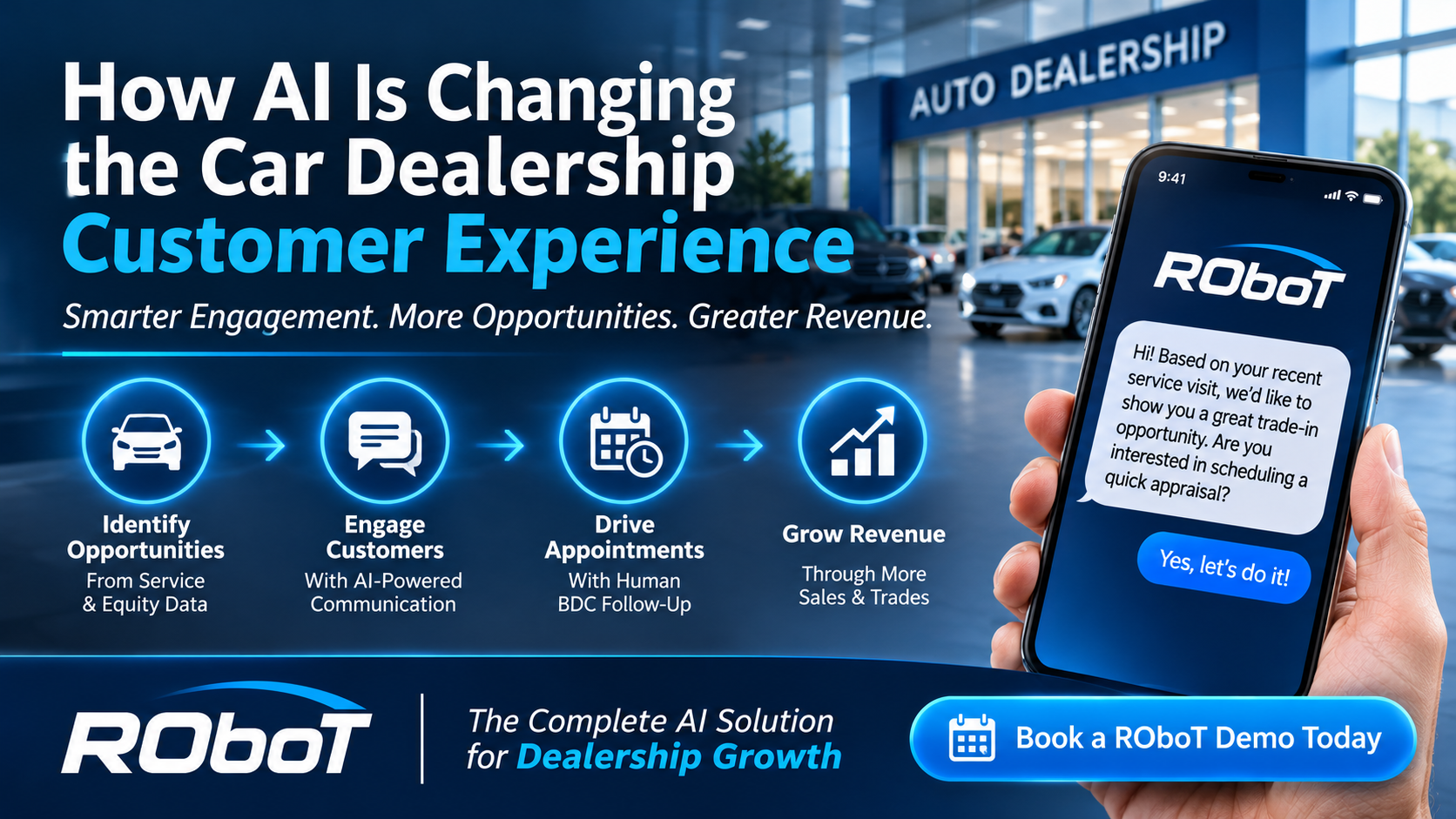
ROboT analyzes repair order information and vehicle equity data to help identify customers who may present a vehicle acquisition or sales opportunity.
Rather than allowing these opportunities to remain buried in car dealership data, ROboT helps bring them to the attention of the team.
The process can include:
- Analyzing repair orders and vehicle information.
- Identifying potential equity and vehicle opportunities.
- Initiating targeted customer engagement.
- Facilitating appraisal conversations through text.
- Qualifying interested customers.
- Supporting BDC follow-up and appointment setting.
This creates another opportunity for the car dealership to connect its service and sales operations.
The service department is no longer viewed exclusively as a maintenance destination. It can also become an important source of customer engagement, vehicle acquisition, and additional revenue opportunities.
3. AI and Human BDC Teams Work Better When They Work Together
There is an important distinction between automated messaging and a complete customer engagement strategy.
Many car dealership technology solutions focus on sending automated texts, responding to inquiries, or managing customer follow-up.
But sending a message doesn’t guarantee a conversation.
And a conversation doesn’t automatically create an appointment.
Car dealerships need a process that moves customers from initial engagement to a qualified opportunity.
This is why combining AI with human BDC personnel is so important.
Why Human Follow-Up Still Matters
AI can help initiate conversations, identify customer interest, and support repetitive communication tasks.
Human BDC personnel can then provide additional attention, answer questions, qualify opportunities, and help customers move toward the next step.
ROboT combines AI-driven engagement with human BDC calls and follow-up to help create a more connected process.
For car dealership management, this distinction matters.
The objective isn’t to measure success by the number of automated texts sent. It’s to understand how many meaningful opportunities were created and what happened after customers responded.
That means focusing on:
- Customer engagement.
- Qualified opportunities.
- BDC conversations.
- Appointments scheduled.
- Appointments completed.
- Vehicles acquired.
- Additional sales opportunities.
When AI and people work together, car dealerships can build a more effective customer engagement process without relying exclusively on manual outreach.
4. AI Can Help Dealerships Create a More Personalized Customer Experience
Today’s customers don’t want to feel like another name on a marketing list.
They want communication that is relevant to their situation.
A customer who recently visited the service department may have different needs than someone who submitted an online vehicle inquiry or previously expressed interest in trading in their vehicle.
AI can help car dealerships use available information to make customer interactions more relevant.
For example:
Service customer: A customer recently completed a repair visit. The dealership identifies a potential vehicle opportunity and initiates a conversation about an appraisal.
Potential trade-in customer: A vehicle owner may have equity in their current vehicle. The dealership can initiate a conversation to determine whether they would consider an appraisal or upgrade.
Existing dealership relationship: A customer who already knows the dealership may be more receptive to a relevant conversation than a completely unfamiliar prospect.
These interactions create opportunities for car dealerships to communicate with greater context.
ROboT is designed to help dealerships turn repair order and equity information into targeted customer engagement rather than relying solely on broad, generic marketing campaigns.
5. Dealership AI Should Generate Business Outcomes, Not Just Activity Reports
This is where car dealership leaders need to take a closer look at the AI solutions they are considering.
There is no shortage of automotive technology promising automation, efficiency, and better customer communication.
But General Managers should ask a more important question:
What does this technology actually produce for my dealership?
A platform may report thousands of messages sent, hundreds of automated interactions, or improved response times.
Those numbers can be useful, but they don’t tell the entire story.
A dealership needs to understand what happens after the initial interaction.
Does the technology generate qualified opportunities?
Are customers responding?
Are appointments being scheduled?
Are vehicles being acquired?
Is the dealership creating additional sales opportunities?
ROboT focuses on connecting these stages of the process.
Its approach is built around identifying opportunities, engaging customers, combining AI with human BDC follow-up, and helping dealerships move those opportunities toward measurable business outcomes.
For dealership management, this changes the conversation from software activity to dealership performance.
6. Turning Existing Dealership Data Into New Revenue Opportunities
Car dealerships already collect enormous amounts of customer and vehicle information through their daily operations.
The challenge isn’t necessarily a lack of data.
The challenge is identifying actionable opportunities within that data and having a consistent process to engage those customers.
Repair orders, vehicle equity information, customer history, and dealership records can help reveal opportunities that might otherwise go unnoticed.
ROboT helps dealerships put this information to work.
By analyzing repair order and equity opportunities, initiating customer conversations, and supporting appraisal and BDC engagement, ROboT helps dealerships create additional opportunities from customers they already have relationships with.
This is particularly important for dealerships looking to:
- Increase used vehicle acquisition opportunities.
- Create additional sales opportunities from service customers.
- Improve service-to-sales engagement.
- Support BDC productivity.
- Reduce missed customer opportunities.
- Make better use of existing dealership data.
Rather than depending exclusively on new leads from advertising and third-party sources, dealerships can develop another channel for generating opportunities from their existing customer base.
7. What Should General Managers Look for in an AI Car Dealership Solution?
Not all automotive AI solutions are designed to accomplish the same objectives.
Some focus primarily on customer communication. Others concentrate on CRM automation, lead response, or digital retailing.
When evaluating AI technology for a car dealership, General Managers should look beyond the feature list.
Here are seven important questions to ask:
- Can the platform identify opportunities within existing dealership data?
- Can it analyze repair orders and vehicle equity?
- Can it initiate relevant customer conversations?
- Can it support appraisal and vehicle acquisition opportunities?
- Does it combine automated engagement with human BDC follow-up?
- Can it help move customers toward qualified appointments?
- Can dealership management evaluate the actual business outcomes?
These questions help separate basic communication automation from solutions designed to support a broader dealership growth strategy.
ROboT brings these elements together into a connected approach to service-lane opportunity identification, customer engagement, and BDC follow-up.
Why Car Dealerships Are Looking at ROboT
ROboT was developed around an important car dealership opportunity: identifying potential business within the customers and vehicle information dealerships already have.
Instead of focusing exclusively on responding to incoming leads, ROboT helps car dealerships proactively identify customers who may be interested in selling, trading, or upgrading their vehicles.
Here is what makes the approach different:
Opportunity Identification
ROboT analyzes repair order information and vehicle equity to help identify potential sales and acquisition opportunities.
AI-Powered Customer Engagement
Targeted text engagement helps initiate conversations with customers who may have an interest in an appraisal or vehicle opportunity.
Appraisal Opportunities Through Text
ROboT supports appraisal conversations through text, helping create a convenient path for customers to express interest.
AI and Human BDC Integration
AI-driven engagement works alongside human BDC calls and follow-up to help qualify opportunities and move customers toward appointments.
A Focus on Measurable Results
The objective is to help dealerships turn identified opportunities into customer conversations, appointments, vehicle acquisitions, and additional sales.
ROboT also works with dealership technology environments that include systems such as CDK, Reynolds, Dealertrack, and vAuto, supporting integration into existing dealership workflows.
For car dealerships looking to get more from their service drive and existing customer relationships, this approach creates an additional opportunity for growth.
The Future of Automotive Customer Experience Is Connected, Intelligent, and Proactive
AI is not simply another technology trend for the automotive industry.
It represents a fundamental shift in how dealerships can identify opportunities, communicate with customers, and manage the customer experience.
The car dealerships that get the most value from AI will be those that look beyond automation alone.
They will focus on connecting customer data, sales opportunities, service operations, and human engagement into a process that supports measurable business results.
For General Managers, this means asking a different question.
Instead of asking, “How can we automate more tasks?”
Ask, “How can we use the information and customer relationships we already have to create more dealership business?”
That’s the opportunity behind ROboT.
See What ROboT Can Do for Your Dealership
Your car dealership may already have valuable sales and vehicle acquisition opportunities hiding within its service drive and existing customer database.
The question is whether your current process is identifying and engaging those customers.
ROboT helps dealerships uncover potential opportunities, initiate targeted customer engagement, and combine AI with human BDC follow-up to create a more connected path from opportunity to appointment.
General Managers, Dealer Principals, and dealership leadership teams: It’s time to see what a more intelligent approach to dealership customer engagement can accomplish.
Book a ROboT demonstration and see how your dealership can turn existing customer relationships into additional business opportunities.
Schedule your ROboT demo today: Send us a message or give us a call now!
Don’t just automate your dealership. Create more opportunities to grow it.
1. How is AI changing the car dealership customer experience?
AI is helping dealerships improve customer experiences through faster communication, personalized engagement, automated follow-up, and better identification of customer needs. It also helps dealerships identify sales and vehicle acquisition opportunities within existing customer data.
2. How can AI help car dealerships increase sales?
AI can help dealerships identify potential buyers and sellers, analyze vehicle equity, initiate customer conversations, support BDC follow-up, and generate qualified appointments. These processes can create additional sales and vehicle acquisition opportunities.
3. What is AI-powered BDC automation?
AI-powered BDC automation uses artificial intelligence to support customer engagement, communication, and follow-up. When combined with human BDC personnel, it can help dealerships qualify opportunities and move customers toward appointments.
4. How can dealerships generate leads from their service departments?
Dealerships can analyze repair orders, vehicle information, and equity opportunities to identify service customers who may be interested in selling or trading their vehicles. AI solutions like ROboT help initiate targeted customer engagement around these opportunities.
5. What makes ROboT different from other automotive AI solutions?
ROboT combines repair order and equity opportunity identification, AI-powered customer engagement, appraisal conversations through text, and human BDC follow-up. Its approach focuses on connecting the process from identifying opportunities to generating appointments and additional dealership business.
6. Can AI replace dealership BDC employees?
AI can automate and support certain repetitive communication and follow-up activities, but human BDC personnel remain valuable for customer conversations, qualification, relationship building, and appointment coordination. ROboT combines AI engagement with human BDC follow-up.
7. Why should General Managers consider AI for their dealerships?
AI can help General Managers identify missed opportunities, improve customer engagement, support car dealership productivity, and create additional revenue opportunities from existing customer relationships.